
Weekly autopsies of failed innovation assumptions. No success stories, just forensic analysis of what actually happened in deep tech and early-stage ventures.

Stay tuned

Don’t miss out on the latest issues. Sign up now to get access to the library of members-only issues.

jamie@example.com
Destruction Desk

Innovation Funding Is Not Broken. It Just Works Differently Now — And That's the Problem

Innovation Funding Is Not Broken. It Just Works Differently Now — And That's the Problem
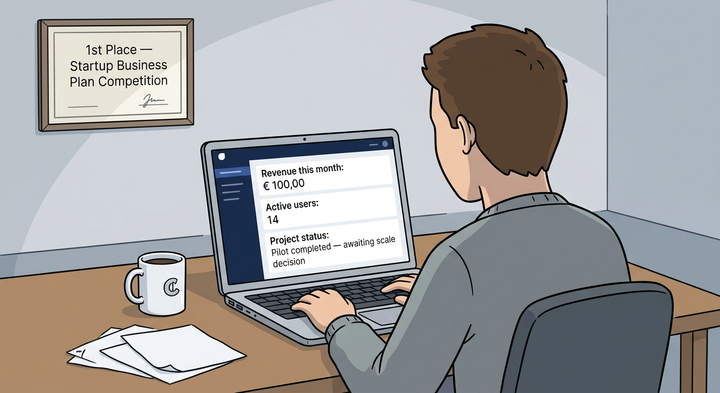
The fractures in innovation funding are structural, not cyclical. (Image generated: Perplexity, 2026)

AI mega-deals are pulling venture numbers upward. The deal count — the one that actually tells you whether founders like you are getting funded — quietly fell 20.6% in 2025. Innovation funding is a tale of two worlds right now. Most business plans were written for a third one that no longer exists.


The Ground Has Shifted. Here Is What the Numbers Actually Show.

Start with the headline that matters least: global venture capital is technically still flowing. Now start with the one that matters most: global private equity and VC fundraising is on track for its worst year since 2016. The aggregate looks tolerable because a handful of late-stage AI infrastructure deals are distorting the totals. Strip those out and the underlying picture is a funding freeze for the majority of the innovation ecosystem.

This bifurcation is the structural fact to hold onto. European venture debt reached €5.9B in Q1 2026, pacing 18% above 2025 — a headline that looks bullish. Average deal size has nearly tripled. Deal count, meanwhile, is on track for its fourth consecutive annual decline (78 deals). Volume tells you who is actually getting funded: a shrinking pool of late-stage companies large enough to absorb institutional debt, using it to delay an equity round that would force a valuation reckoning. Early-stage and non-AI companies cannot access this market. They are either taking the valuation hit or quietly shutting down.

One quantitative anchor: the Chicago Fed's National Financial Conditions Index (NFCI) measures tightness across money markets, debt, equity, and the banking system — negative values mean looser than historical average, positive means tighter. In March 2026 it averaged –0.475, meaning US financial conditions remain technically loose. This is the number that reassures CFOs and LPs. What it does not capture is the K-shaped reality beneath it: high-asset borrowers are fine; everyone else is running on margin compression and sticky energy costs. The subindex to watch is not the headline — it is the nonfinancial leverage component, which tracks business debt stress and historically moves before the composite does.

The oil and inflation transmission to innovation funding does not hit immediately — it runs on a 3-to-18-month lag. The squeeze arrives precisely when your next round is due.

Many founders are waiting out a cycle that is not coming back. The bifurcation between AI mega-rounds and everyone else, the concentration of venture debt into fewer and larger deals, the return to 2016-level fundraising volumes — these are not side effects of high interest rates that reverse when the Fed cuts. They reflect a deeper shift in how capital allocates to innovation: toward fewer, larger, later-stage bets with clearer near-term returns, and away from the broad early-stage distribution that defined 2015–2021. Adjusting your plan to the cycle will not be enough. The baseline has moved.

→ Sidebar A: The Regional Financing Map — how conditions differ for founders in the US, Europe, and Japan. (See companion block)

A Note on Financing Architecture Before We Go Further

Innovation funding does not happen in a vacuum. How a startup or deep tech company is financed — equity rounds, venture debt, convertible instruments, special purpose vehicles, corporate R&D budgets, or hybrids of several — determines its exposure to the conditions described above in very different ways. Each instrument carries covenants, compliance triggers, and incentive structures that behave differently under stress. In the US context, mechanisms like Section 409A valuations create specific compliance cascades when equity values drop that affect employee retention and cap table dynamics in ways founders rarely model in advance. European equivalents exist under different regulatory frameworks. The point is not the specific instrument — it is that the architecture of your financing is itself an assumption that needs stress-testing.

→ Sidebar B: How a Down Round Becomes a Retention Crisis — the mechanics of valuation resets and their downstream effects on equity incentives. (See companion block)

The Assumption Audit: When Did You Last Update Yours?

Every business plan rests on assumptions about how financing works. Most were formed in a specific environment. Below is a three-tier hierarchy — start at the top, which applies regardless of where you are in your funding journey, and work down to what is relevant to your stage and sector.


Tier 1 — Assumptions Every Founder Is Carrying Right Now

The assumption: The IPO window will reopen next year. The reality: It has been "next year" since 2022. Surveys of CFOs show 59% expect inflation to persist through 2027, which delays IPOs and compresses the strategic M&A market that serves as a secondary exit path. A 7-to-10-year hold period is no longer a tail scenario — it may be the base case. Most cap tables and investor agreements were not structured for it.

The assumption: My cash is safe because it's in the bank. The reality: FDIC protection covers $250,000 per depositor. Above that, your exposure depends entirely on what your "bank" actually is. Several fintech platforms sweep deposits into money market vehicles without pass-through deposit insurance. In a credit seizure, the distinction between a bank deposit and a swept MMF becomes operational within 48 hours. Most founders patched the surface concern after SVB. Fewer audited the structural one.

The assumption: My risks are diversified because my customers, investors, and suppliers are in different regions. The reality: Geographic diversification is not risk diversification. The second-order correlation is what matters: a single geopolitical event can simultaneously compress your customers' margins, tighten your investors' liquidity, and disrupt your suppliers' logistics. You may be diversified against the location, not the event.


Tier 2 — Assumptions That Depend on Your Funding Stage

The assumption: Venture debt is safer than taking an equity round right now. The reality: Venture debt agreements routinely contain Material Adverse Change clauses that allow lenders to call loans if they determine conditions have deteriorated — independently of your performance. In an environment where oil at $110 spooks risk committees, an outperforming startup can still face a loan call. The bridge may be a trapdoor. Read the covenant before you sign.

The assumption: I can access the secondary market for founder liquidity when I need it. The reality: Secondary markets freeze in precisely the conditions when you most need them. If this optionality is not already structured into your plan with a realistic timeline and a named counterparty, it is an assumption, not a strategy.

The assumption: We will retain key engineers through the downturn because they hold equity. The reality: A down round triggers a valuation reappraisal of common stock that can push employee option strike prices above the new fair market value — turning unvested equity into a paper loss. All available remedies (repricing, refresh grants, anti-dilution adjustments) carry costs that fall on founders and early common holders, not preferred investors. The retention tool evaporates exactly when you most need stability.


Tier 3 — Assumptions Specific to Deep Tech and Corporate Innovation

The assumption: Our R&D budget is protected because it's labelled strategic. The reality: In a zero-based budgeting exercise during a sustained oil shock, "strategic" competes directly with "cost avoidance." If your project cannot articulate how it reduces OpEx or secures supply within 12 months, the protection may exist only on a slide deck.

The assumption: The startup we depend on will still exist in 18 months. The reality: If you are building critical infrastructure on a Series A company's API or technology, audit their burn multiple now. Net burn running at 2.5x revenue or above in this environment is a warning signal. Your IP escrow agreement needs legal stress-testing, not filing.

The assumption: USD-denominated financing will remain accessible at roughly current terms. The reality: This is the assumption that rarely gets written down because it has been true for so long it stopped feeling like an assumption. If the term premium on US debt rises structurally — which fiscal dominance scenarios make plausible — the cost of equity capital shifts for everyone. Does your model work at a 7% cost of equity? At 9%?


What the Data Shows vs. What the Headlines Suggest

Three readings currently being misinterpreted:

European venture debt is up 18% by value. What this hides: deal count is on track for a fourth consecutive annual decline. The market is not recovering broadly — it is concentrating. If you are not a late-stage AI infrastructure company, the headline surge is not describing your market. Source: PitchBook, Q1 2026 European Venture Report (pitchbook.com/news/reports/q1-2026-european-venture-report

US financial conditions remin technically loose. The Chicago Fed's NFCI stood at –0.433 for the week ending April 3, 2026 — still negative, meaning US financial conditions remain looser than their historical average. What this hides: the nonfinancial leverage subindex moves before the composite does. Conditions that look stable in aggregate are already tightening at the margin where early-stage companies operate. Source: https://fred.stlouisfed.org/series/NFCI

Global VC fundraising fell to $118 billion in 2025 — a 46% drop year-on-year and the lowest total in roughly a decade, according to PitchBook. Q1 2026 shows no meaningful recovery.What this means for the pipeline: fewer funds raised in 2026 means fewer investments in 2027–2028, which means fewer Series B/C candidates in 2028–2029. The suppression of the innovation pipeline is already baked in. It just has not shown up in the failure statistics yet.


Open Questions

  • If the AI mega-round cycle reverses — as previous consensus trades have — what happens to the venture debt raised specifically to avoid triggering a valuation reset?
  • Which second-order effect of higher-for-longer rates are you currently ignoring because it has not hurt you yet?
  • When did you last stress-test your financing assumptions against a scenario where nothing returns to 2021 conditions — not next year, not in three years, not ever?
  • Who benefits from founders believing the IPO window is perpetually "about to reopen"?
  • What is the failure mode you would need to ignore in order to maintain your current plan unchanged?

These are not predictions. They are pressure tests. The goal is not to have answers today — it is to identify which questions your last business plan never asked.


Destruction Desk
We perform autopsies on innovation’s failed assumptions.


This newsletter was edited by Manfred Lueth.


You received this email because you signed up for this newsletter from DestructionDesk.com. To stop receiving this newsletter, unsubscribe or manage your email preferences.

Latest issue